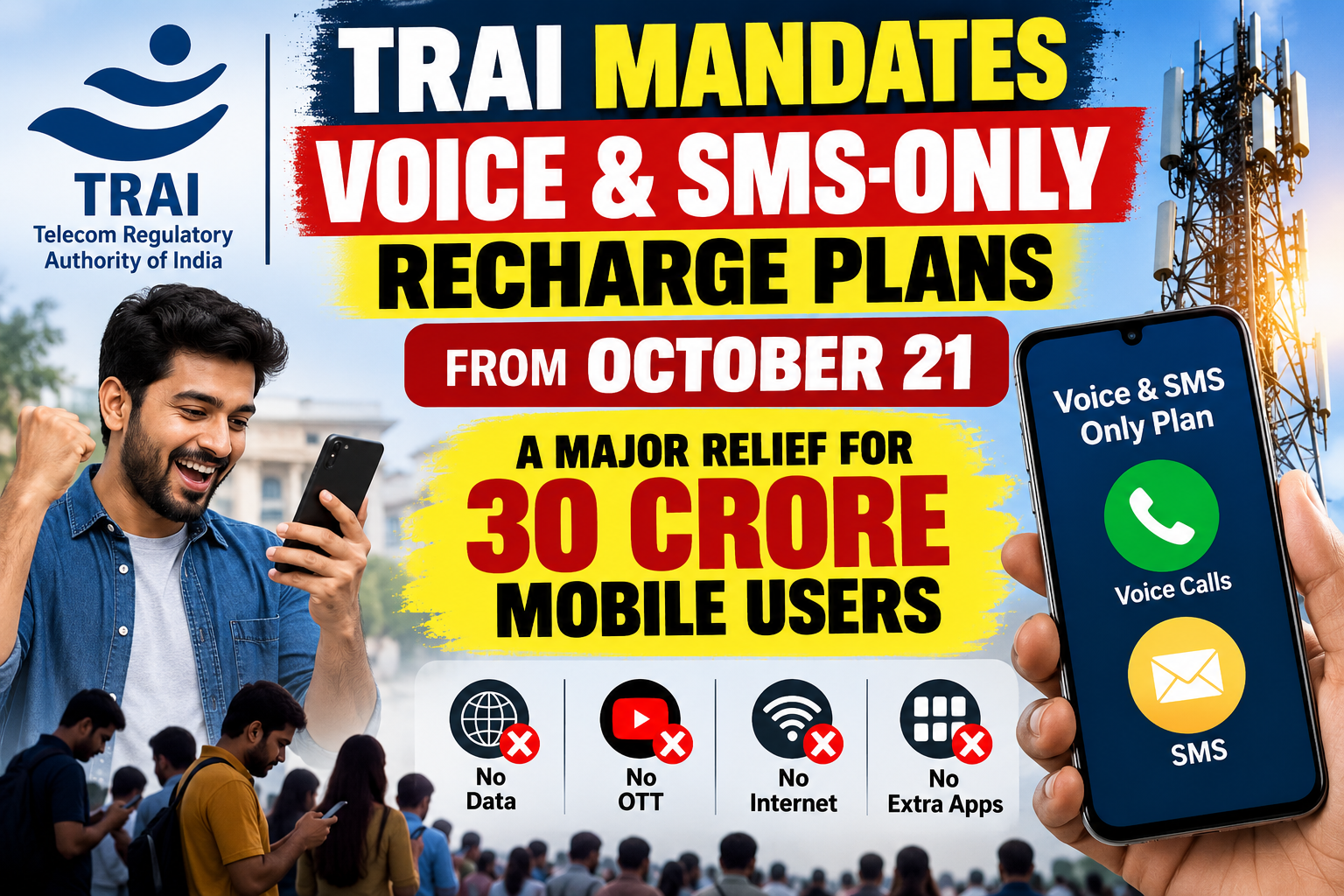
TRAI Mandates Voice & SMS-Only Recharge Plans from October 21: A Major Relief for 30 Crore Mobile Users
By [gnansethu] | Published: September 24, 2026
In a landmark decision that promises significant financial relief for millions of Indian mobile subscribers, the Telecom Regulatory Authority of India (TRAI) has mandated that telecom operators—including Airtel, Reliance Jio, and Vodafone Idea—roll out dedicated voice and SMS-only recharge plans starting October 21, 2026. The move is set to benefit nearly 30 crore feature phone users and low-income consumers who do not require bundled mobile data but have been forced to pay for it simply to keep their connections active.
What Exactly Has Changed?
Under the newly notified Telecom Consumer Protection (Thirteenth Amendment) Regulations, 2026, telecom companies are now legally required to offer voice-and-SMS-only Special Tariff Vouchers (STVs) across every validity period where they currently offer bundled voice, SMS, and data plans. This means if an operator sells a 28-day or 30-day plan with data, they must also provide a corresponding voice-and-SMS-only option with the same validity—but at a proportionately lower price.
Crucially, TRAI has mandated three specific categories of non-data plans:
- Short-validity plans: Voice-and-SMS-only options for every validity period of 30 days or less that matches existing bundled plans.
- True monthly renewal plans: At least one plan that can be renewed on the same date every month, rather than the rigid 28-day billing cycles that operators have historically enforced.
- Longer-validity options: At least one voice-and-SMS-only plan with a validity longer than the monthly option, corresponding to longer-duration bundled plans.
Why Is TRAI Taking This Step?
This regulatory intervention follows a failed first attempt. In December 2024, TRAI had already mandated that operators offer at least one voice-and-SMS-only plan with validity up to 365 days. However, the regulator found that telecom companies exploited loopholes—offering only a handful of such plans, almost exclusively with long validities of 80–84 days or 336–365 days. These high upfront costs effectively locked out low-income users who needed short, affordable recharge options.
TRAI’s explanatory memorandum noted that operators initially did not reduce prices proportionally when removing data from plans, only doing so later after “public discontent”. The new amendment is designed to close these gaps by requiring parity across all validity periods, not just token offerings.
The regulator has framed this as a consumer protection measure. As TRAI stated, the framework “would sufficiently address consumer requirements” by allowing low-income consumers to “recharge according to their requirements and financial capacity”. The beneficiaries include senior citizens, feature-phone users, rural populations, and individuals maintaining secondary SIM cards for OTPs and banking alerts—groups that have been disproportionately penalised by the lack of unbundled plans.
The Telecom Industry Pushed Back—and Lost
The mandate was not welcomed by India’s private telecom operators. During TRAI’s consultation process, which received 1,132 stakeholder responses and included an Open House Discussion on June 15, 2026, all three major private telcos formally opposed the proposal.
Reliance Jio argued that standalone voice plans are “technically incompatible” with modern 4G and 5G networks, which are built on IP-based infrastructure where voice operates as an application over data. The company also warned that cheap, short-validity voice plans could lower the cost barrier for scammers, potentially fueling unsolicited commercial communication and cyber fraud. Jio further claimed that 88% of its entry-level subscribers actively use data and that existing voice-only plans have seen limited uptake.
Vodafone Idea cautioned that removing data from plans could expose users to unexpected pay-as-you-go charges, as background data consumption—for software updates, OTP verification, and app functions—might trigger bill shocks.
Airtel contended that voice-only packs could create a “structurally data-excluded segment” at a time when India’s digital public infrastructure is increasingly mobile-first.
Consumer groups, however, countered that non-data users have effectively been subsidising data-heavy subscribers to the tune of tens of thousands of crores annually in unused data entitlements. They also pointed out that in remote and hilly regions, towers often fail to deliver reliable data, yet users are still forced to pay for bundled internet they cannot use.
TRAI ultimately overruled the industry objections, citing the roughly 150 million subscribers who use basic feature phones and do not need data services.
What This Means for You
If you are a mobile user who primarily relies on calls and SMS—or if you use a secondary SIM that only needs to stay active for incoming messages and OTPs—you will soon have significantly more affordable options.
For example, instead of purchasing a ₹199 plan that bundles 2GB of data you may never use, you will be able to select a voice-and-SMS-only plan with the same 28-day validity at a proportionately lower price. For dual-SIM users, this means the second connection can be maintained purely for calls and texts without paying for redundant data.
TRAI has not prescribed an exact pricing formula but has directed operators to offer an “appropriate reduction” based on the average revenue they earn per GB of data. With average wireless data revenue declining from ₹9.11 per GB in March 2025 to ₹7.51 per GB in March 2026, consumers can reasonably expect meaningful savings.
What to Watch For
While the mandate takes effect on October 21, the real test will be whether operators price these plans competitively or find subtle workarounds to limit their appeal—as consumer advocates allege happened after the 2024 mandate. Analysts at Morgan Stanley have warned that the change could drive churn among entry-level subscribers, potentially leading to industry-wide tariff hikes as operators seek to offset revenue dilution.
For now, however, the regulatory direction is clear: telecom companies can no longer force customers to pay for data they don’t need. As TRAI has signalled, the era of bundling voice and SMS with mandatory data is coming to an end for those who simply want to stay connected.
What do you think of TRAI’s new mandate? Will you switch to a voice-and-SMS-only plan? Share your thoughts in the comments below.