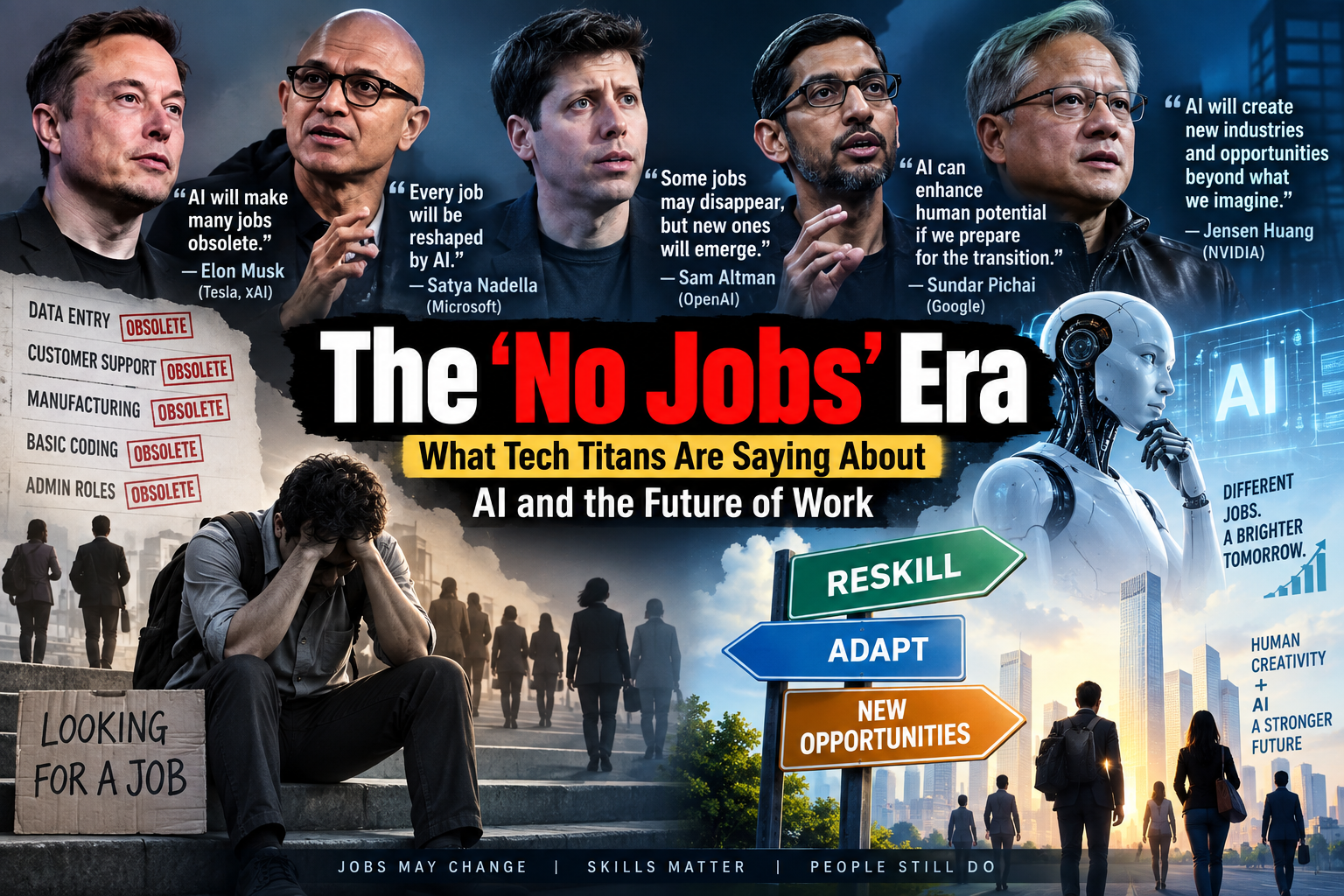
The “No Jobs” Era: What Tech Titans Are Saying About AI and the Future of Work
“AI will be able to do 80% of all jobs by 2030.” That’s not a sci-fi novelist’s fever dream. It’s the prediction of Vinod Khosla, the billionaire venture capitalist who backed OpenAI before almost anyone else believed .
Khosla isn’t alone. Over the past year, some of the most powerful people in technology have been publicly—and sometimes brutally—honest about what artificial intelligence means for human employment. Their messages range from apocalyptic to utopian. But they all agree on one thing: the nature of work is about to change forever.
The Grim Prophets
Geoffrey Hinton, the Nobel laureate known as the “Godfather of AI,” has become one of the technology’s most prominent doomsayers. In a conversation with Senator Bernie Sanders in late 2025, Hinton was blunt about why tech companies are pouring trillions into AI infrastructure: “These guys are really betting on AI replacing a lot of workers” .
His logic is uncomfortably simple. Companies are spending roughly a trillion dollars on data centers and chips. That money needs a return. The cheapest way to get it? Replace human workers with AI that does the same job for less.
Hinton warns of “massive unemployment” and a scenario where “rich people are going to use AI to replace workers”—creating a world where a few become vastly richer while most become poorer. He’s careful to note that this isn’t AI’s fault. “That’s not AI’s fault, that is the capitalist system” .
His time horizon for when this gets serious? He’s honest about the uncertainty. “It’s a bit like when you drive in fog. You can see clearly for 100 yards and at 200 yards you can see nothing. Well, we can see clearly for a year or two, but 10 years out, we have no idea” .
Dario Amodei, CEO of Anthropic, has been sounding a similar alarm—but with a specific focus on white-collar jobs. In a Fox News interview, he warned that entry-level positions in finance, consulting, and tech are first in the crosshairs: “I worry that those things are going to be first augmented, but before long replaced by AI systems” .
Amodei’s prediction: “I would not be surprised if somewhere between one and five years, we started to see big effects here.”
The Radical Optimists
Then there’s Elon Musk, who sees the same disruption but paints it as liberation rather than catastrophe.
Musk has repeatedly argued that AI and robots will create such immense abundance that work itself becomes optional. His solution? “Universal high income”—government checks funded by the productivity of machines. “AI/robotics will produce goods & services far in excess of the increase in the money supply, so there will not be inflation,” he wrote on X. “Everyone can have a penthouse if they want” .
Khosla offers a similar vision. He imagines a world where AI makes expertise—legal advice, medical guidance, education—essentially free. “The cost of almost everything collapses when labor becomes effectively free,” he says. For today’s five-year-olds, he predicts: “A five-year-old today is unlikely to need a job in the traditional sense when they grow up. The work that survives will be work people choose, not work they are compelled to do to survive” .
The Skeptics
Not everyone is buying the doom—or the utopia.
Sam Altman, OpenAI’s CEO, has notably walked back his own earlier warnings. “I don’t think we’re going to have the kind of jobs apocalypse that some of the companies in our space advocate or talk about,” he said in May 2026. He even suggested that companies loudly blaming AI for layoffs might be using AI the least .
Jensen Huang, Nvidia’s CEO, is even more dismissive. He called AI job loss fears “complete nonsense” and criticized executives who use AI as a scapegoat for layoffs: “It was just a way for them to sound smart, and I really hate that. I think we’re scaring people, and that’s irresponsible” .
The data offers some ammunition to both sides. A World Economic Forum analysis suggests AI could displace 92 million jobs by 2030—but create 170 million new ones, a net gain of 78 million . Yet entry-level hiring is already contracting: Anthropic’s own research found a 14% decline in hiring for 22-to-25-year-olds in AI-exposed roles since ChatGPT launched .
What It Actually Means
Strip away the personalities and the predictions, and a few practical realities emerge.
The first wave is white-collar, entry-level, screen-based work. Summarizing documents, drafting reports, basic coding, customer service—tasks that are predictable and rule-bound are most vulnerable .
The physical world is a temporary shelter. Plumbers, electricians, nurses, chefs—jobs that require moving through unpredictable physical spaces—have more time. But Musk predicts humanoid robots will eventually close that gap too .
The transition is the dangerous part. Michael Burry, the investor famous for predicting the 2008 housing crash, offered a sharp response to Musk’s utopian vision: “False. There will be revolution first” . If millions are displaced faster than societies can adapt, the promised abundance might arrive alongside profound instability.
Policy will determine the outcome. Khosla has proposed taxing AI-driven productivity and eliminating preferential capital gains treatment to fund support for displaced workers . Amodei has even suggested AI companies might need to be taxed like the workers they replace .
The Uncomfortable Question
What none of the billionaires can fully answer is what happens to human dignity when work is no longer required. Hinton has dismissed universal basic income as insufficient because “it won’t deal with human dignity” and the value people derive from having a purpose .
Perhaps that’s the real challenge. Not whether AI can do 80% of jobs. But whether we can build a society where the other 20%—and the people who do them—still matter.